
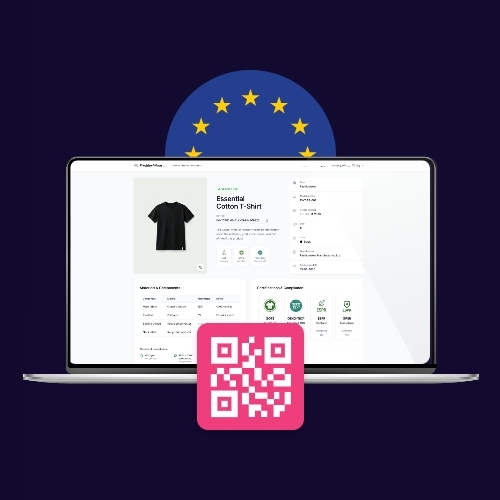
What is the EU's digital product passport (DPP)?

_image_2.jpg "What is the EU's digital product passport (DPP)? - pimmix_eu_digital_product_passport_(dpp)_image_2")
Why is the EU introducing the Digital Product Passport?
The goal of the Digital Product Passport is to support the EU’s circular economy strategy and improve product transparency in the market.
In the future, product-related information may include for example:
-
material composition
-
information related to repairability
-
information about the product’s origin
-
environmental and carbon footprint data
-
instructions related to recycling and disposal
With this information, consumers and companies can make better decisions regarding the use, maintenance, and recycling of products.
Will the Digital Product Passport apply to all products?
The Digital Product Passport will not be introduced for all products at once. The EU will implement the system gradually across different product categories.
Some of the first product groups likely to fall under DPP requirements include:
-
textiles
-
batteries and electronics
-
construction products
-
furniture
-
metals and material industries
The exact data requirements will be defined separately for each product category.
What does the Digital Product Passport mean for companies?
For many companies, the Digital Product Passport is not only a new reporting obligation. It is more broadly connected to how product data is managed and shared.
In practice, DPP requires product data to be:
-
structured
-
up to date
-
easy to update
-
connectable across multiple data sources
-
shareable between systems and stakeholders
If product information is scattered across Excel files, supplier documents, ERP systems, and emails, collecting the data required for a Digital Product Passport can quickly become labor-intensive.
Why manual product data management is usually not enough
Many companies manage product data across several different systems. Some information comes from suppliers, some is created internally, and some is needed for different distribution channels.
Typical challenges include for example:
-
the same information is maintained in multiple places
-
updates do not transfer to all systems
-
product data structures vary between different sources
-
combining data requires a lot of manual work
When DPP introduces additional data requirements, the importance of product data management becomes even greater.
How does product data management relate to the Digital Product Passport?
The Digital Product Passport is fundamentally based on product data. To implement DPP efficiently, companies must be able to collect, combine, and manage product information centrally.
This often means that a company has for example:
-
a centralized product data management system
-
a clear data structure for products
-
the ability to combine information from multiple sources
-
the capability to convert data into different formats and standards
When product data is structured and properly managed, meeting new requirements such as the Digital Product Passport becomes significantly easier.
How can Pimmix help companies prepare for the Digital Product Passport?
Although the exact requirements of the Digital Product Passport will be defined separately for each product category, one thing is already clear: product data management will play an increasingly important role.
Pimmix is a platform designed for product data management that helps companies collect, combine, and manage product information centrally.
With Pimmix, companies can for example:
-
collect product data from suppliers
-
combine information from multiple sources into one structured model
-
manage product data centrally in one place
-
enrich and complete product data
-
convert information for different systems and standards
When product data is structured and managed properly, companies are better prepared to respond to upcoming DPP requirements without having to build everything as a separate project.
Frequently asked questions about the Digital Product Passport
What is a Digital Product Passport (DPP)?
A Digital Product Passport is a digital information set related to EU regulation that contains key information about a product and its lifecycle.
Is the DPP based on EU legislation?
Yes. The Digital Product Passport is part of the EU Ecodesign for Sustainable Products Regulation (ESPR).
When will the Digital Product Passport come into force?
DPP will be introduced gradually for different product groups in the coming years. Exact timelines will be defined in product-specific regulations.
What kind of information can a Digital Product Passport contain?
Information may include material composition, environmental impact, repairability, safety, and recycling-related information.
How can companies prepare for the Digital Product Passport?
Companies can prepare by ensuring that product data is structured, up to date, and centrally managed, making it easier to meet new data requirements.

Markus Rahkonen
Co-founder
"The Digital Product Passport highlights how important structured product data is for companies. Many organizations still have product information scattered across different systems and documents. When the data is centralized and managed properly, new requirements such as DPP become much easier to implement."
Call | Email | Send a message | Book a demo

Read more about the topic
Explore related topics to learn more about product data management, automation, and integrations. The articles below provide additional insights into how product data can be collected, structured, managed, and shared more efficiently across different systems and channels.

Artificial Intelligence (AI)
Overviews and workflows
Pimmix Publisher
Pimmix View
Product Data Exports
Product Data Imports
Product data management

EU digital product passport is coming
In an era of sustainability and transparency the European Union takes a significant measure with the introduction of the digital product passport. This new measure is set to redefine how product information is shared, promoting an environment of trust and responsibility among consumers, manufacturers, and regulators alike.

Pimmix launches its first AI applications
In a groundbreaking development, Pimmix is proud to unveil its first AI applications, set to revolutionize text and data generation in the product information management context. This cutting-edge tool leverages advanced artificial intelligence to enhance productivity, creativity, and efficiency. With these new applications, users can generate high-quality text and data tailored to their specific needs, marking a significant milestone in our commitment to future innovation.
Digital Product Passport is coming: Pimmix helps without a heavy IT project
The EU Digital Product Passport (DPP) will change how product-related information is collected, maintained and shared. The goal is to make information relevant to a product’s lifecycle available to the right users – consumers, professionals, authorities and other stakeholders. For companies, however, the real challenge is usually not creating a QR code or an online view. The more difficult question is what information is required for each product, where that information currently exists, what is still missing and how everything can be kept continuously up to date. Pimmix solves this entire process.