
Digital Product Passport is coming: Pimmix helps without a heavy IT project
 24-9-2026
 Reading time 2 minutes
Why is the Digital Product Passport relevant right now?
The EU Ecodesign for Sustainable Products Regulation, or ESPR, established a common framework for Digital Product Passports. However, DPP requirements will not be introduced for all products at once. They will be defined gradually by product group. The first ESPR working plan focuses, among other areas, on iron and steel, energy-related products, textiles, tyres, aluminium, furniture, mattresses and ICT products. DPP requirements may also be introduced through other EU legislation.
This means that companies should start preparing before the requirements affecting their own product groups enter into force. A key requirement of the DPP is not only the digital view itself, but also that the underlying information is accurate, complete and up to date. The product passport must also be linked to a persistent unique product identifier, and the data must be structured, interoperable and, where required, machine-readable and transferable.
What does a Digital Product Passport mean in practice?
A Digital Product Passport is a product-specific digital set of information, with its content determined by the product group and the applicable requirements. It may include, for example, product identification data, material and composition information, compliance documentation, instructions for use and safety, as well as information about the manufacturer and other responsible parties. The exact data requirements, and whether the passport must be created at model, batch or individual product level, are defined separately for each product group.
Not all information necessarily needs to be available to everyone. The EU DPP framework is based on the idea that different user groups can access different information depending on their rights and needs. Consumers may, for example, be interested in materials, origin, maintenance and recycling information, while professionals may need technical data and authorities may require compliance-related information.
Make your Digital Product Passport as simple as possible
Pimmix connects DPP requirements with your company’s existing product data. You can see what is required for each product, what information is already available and what is still missing. You complete the necessary data, Pimmix generates the Digital Product Passport, and Conversion Hub takes care of the required data deliveries.
Standalone DPP solution from 65 € / month.
How it works
Pimmix connects DPP requirements with your existing product data and makes the entire process manageable from start to finish. You can see what information is required, what is already available and what is still missing – and publish a complete Digital Product Passport without a separate, heavy IT project.
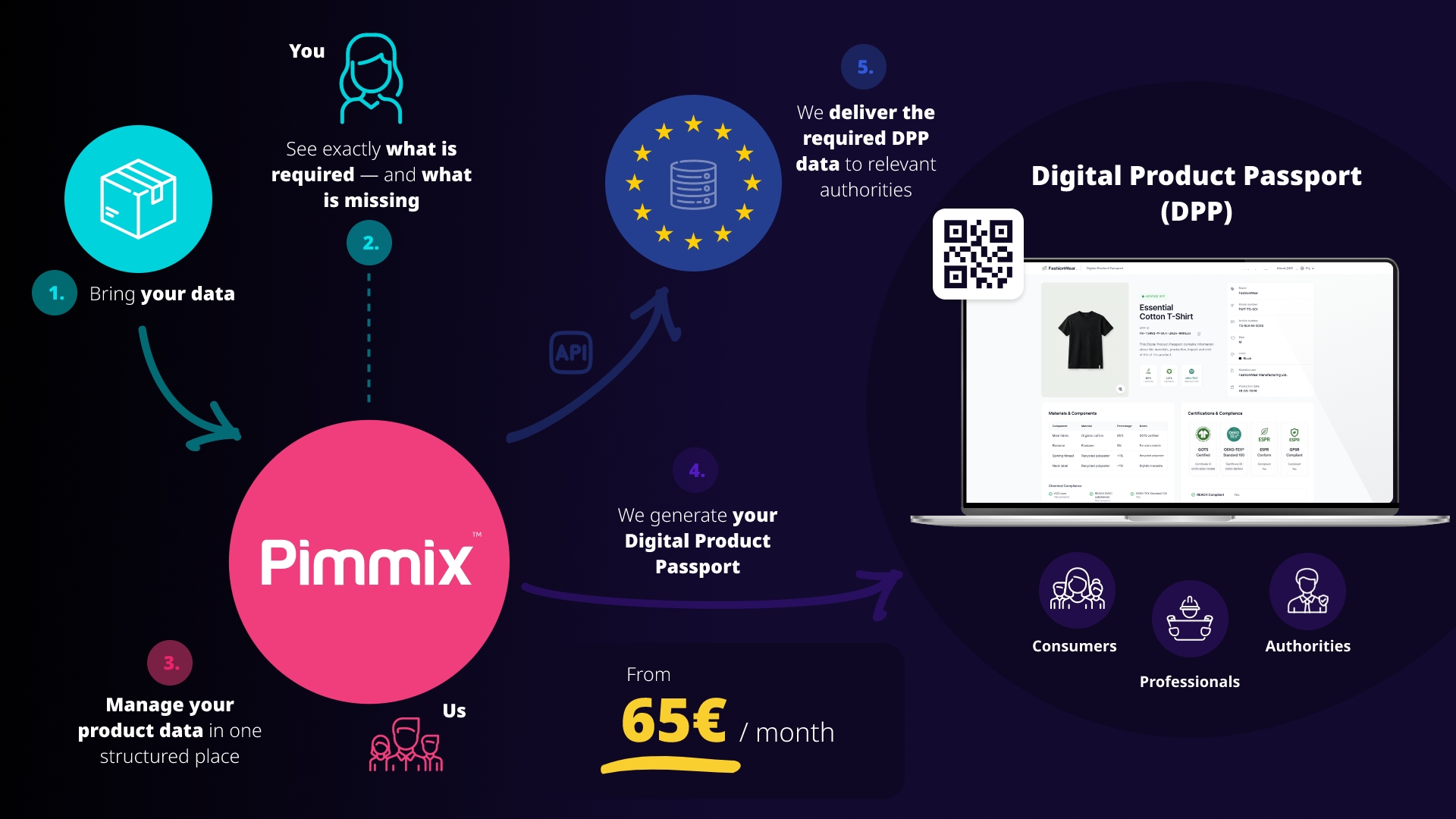
1. We start with the data you already have
You do not need to re-enter all your product information in order to implement DPP.
Existing data can be brought into Pimmix from sources such as ERP systems, your current PIM solution, Excel files or other data sources. The information is mapped to the structure required for DPP so that your existing product data can be reused as much as possible.
This is why Pimmix can also be implemented as a standalone DPP solution alongside your existing systems. If your company already has a working ERP or PIM solution, there is no need to replace it just because of Digital Product Passport requirements.
2. Pimmix knows what is required for each product
DPP requirements can be brought into Pimmix at classification and product-group level. When a product belongs to a specific classification, the system knows which information is expected for that product.
This means your company does not need to maintain separate Excel sheets or manual checklists to track what is still missing from different products. Requirements can be linked directly to the product structure, allowing DPP readiness to be monitored systematically at both product-group and individual product level.
As a result, Pimmix does more than simply store product data. It also gives you a continuous overview of how ready each product is for publication.
3a. Intelligent overviews show immediately what is missing
Once the DPP requirements and your existing product data have been connected, Pimmix overviews show directly what is already in order and where further work is still needed.
Your company can see, for example, which mandatory data is missing completely, which values still require review and which products are already sufficiently complete for publication. This means the DPP project does not need to be managed through separate checklists or manual Excel tracking.
The goal is to help users see immediately where their time and attention are needed, instead of first having to search for problem areas themselves.
3b. Complete your data efficiently – also with AI
Missing information can be completed and maintained directly in Pimmix using the same tools that are available for broader product data management.
Large product volumes can be handled efficiently with bulk editing, structured views and AI-powered tools. AI can be used, for example, to create, enrich and translate product information and to improve existing content.
The idea is that automation handles as much repetitive work as possible, while users focus on the areas that genuinely require decision-making or expert input.
4. Pimmix View creates the actual Digital Product Passport
Once the product information is complete, Pimmix View turns it into a Digital Product Passport that can be opened, for example, via a QR code attached to the product or its packaging.
Pimmix provides a ready-made standard DPP view to keep implementation fast and cost-efficient. If needed, the view can also be customized to match the company’s brand, content requirements or other specific needs as a separate implementation.
The same product data can be presented differently to different users. Consumers can see, for example, materials, origin and recycling instructions, professionals can access technical or maintenance-related information, and authorities can access the compliance information they require.
Once all required information is complete, the Digital Product Passport can be published for use.
5. Conversion Hub takes care of data conversion and delivery
A DPP is not only a visual online view. Part of the information must also be deliverable in machine-readable form to defined target systems.
This is where Pimmix Conversion Hub handles the final step. It converts the product data maintained in Pimmix into the required target structure and delivers the information through APIs to the relevant DPP and authority systems.
From the company’s point of view, the process remains simple. Product data is maintained in one controlled environment, while Pimmix takes care of creating the right views, the right data structures and the right deliveries.
Solve only DPP now – and expand later
Pimmix does not need to be implemented as a large-scale solution from the start.
A company can begin with the Digital Product Passport need alone: bring in its existing data, identify the gaps, complete the required information, publish the DPP and handle the necessary data deliveries.
If broader product data management needs arise later, the same environment can grow with the company. The same information can be used, for example, for product data deliveries to retailers and datapools, ecommerce, customer portals, catalogues, multilingual content and other product information publishing needs.
This means DPP does not have to become a separate compliance project serving only one purpose. You can solve the immediate requirement efficiently first and use the same foundation more broadly later.

Markus Rahkonen
Co-founder
“Digitaalinen tuotepassi ei ole vain uusi EU-vaatimus, vaan hyvä syy laittaa tuotetieto kuntoon. Kun tiedämme, mitä jokaiselta tuotteelta vaaditaan, voimme hyödyntää olemassa olevan datan, tunnistaa puutteet ja automatisoida suuren osan ylläpidosta ja jakelusta. Samalla rakennetaan pohja, jota voidaan hyödyntää paljon laajemmin kuin vain DPP:ssä.”
Call | Email | Send a message | Book a demo