
Digital product passport (DPP) and product information management

_image_4.jpg "Digital product passport (DPP) and product information management - pimmix_eu_digital_product_passport_(dpp)_image_4")
What is the role of product data management in the Digital Product Passport?
The Digital Product Passport requires that product-related information is structured, up to date, and easily accessible. In practice, this means that companies need to have a system or process for collecting, managing, and sharing product data for different purposes.
The DPP is not just a single data field or document. It is a broader entity that brings together product-related information from multiple sources.
This may include for example:
-
technical product data
-
material information
-
information related to the product’s origin
-
environmental and sustainability information
-
information related to repairability and recycling
All of this information must be reliably connected to the same product.
Why does product data management become so important?
In many companies, product data is spread across several different systems and files.
Information may be found for example in:
-
ERP systems
-
Excel files
-
supplier datasheets
-
e-commerce systems
-
marketing materials
When the Digital Product Passport requires information to be shared in a consistent format with different stakeholders, fragmented product data management can create significant challenges.
That is why, for many companies, the DPP also means developing their product data management practices.
How can product data be used in the Digital Product Passport?
The Digital Product Passport does not usually mean creating entirely new data. In many cases, it is about combining and structuring existing product information.
Companies may already have a large share of the required data for example in:
-
product information systems
-
supplier data sources
-
production-related systems
-
documentation
The challenge is often that the data exists in different formats and in different places.
Once the data is brought together into a structured format, it can also be used to support the implementation of the Digital Product Passport.
Why does centralized product data management make DPP requirements easier?
When product data is managed centrally, a company is better able to respond to new product data requirements.
Centralized product data management helps for example to:
-
combine information from multiple sources
-
keep information up to date
-
ensure data consistency
-
share information across different systems and channels
-
create new data structures based on regulatory requirements
This also makes the implementation of the Digital Product Passport considerably easier.
How can the Digital Product Passport be offered to consumers?
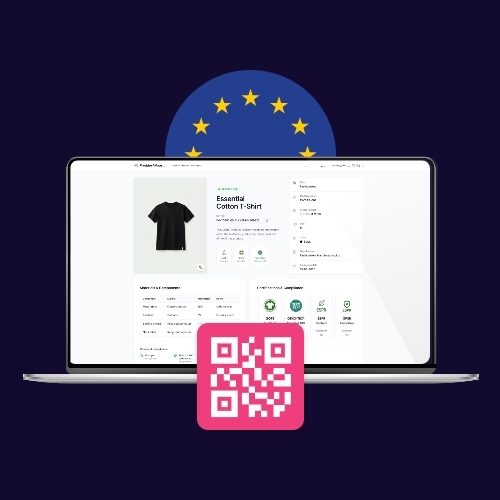
One of the main ideas behind the Digital Product Passport is that product-related information can be made easily accessible, for example through a QR code.
When a consumer or another stakeholder scans a product’s QR code, they can access product-related information in a digital view.
Such a view may include for example:
-
technical product information
-
material information
-
usage and maintenance instructions
-
sustainability information
-
recycling instructions
This type of solution often requires a platform that can combine product data and make it easily accessible.
How does Pimmix support the implementation of the Digital Product Passport?
In practice, the Digital Product Passport is based on well-managed product data. This is where Pimmix can help companies in several ways.
Pimmix makes it possible for example to:
-
collect product data from multiple sources
-
structure and enrich product data
-
manage product data in one place
-
convert product data into different standards and formats
This creates a strong foundation for implementing the Digital Product Passport as well.
In addition, Pimmix’s Extranet functionality can be used as a portal through which product-related information can be provided to external users.
For example:
-
a consumer can open a product’s Digital Product Passport through a QR code
-
retailers can review product information
-
service providers can find repair-related information
The Extranet can be configured for different use cases, and one possible application is providing Digital Product Passport information.
Frequently asked questions about the Digital Product Passport and product data management
How is the Digital Product Passport related to product data management?
The Digital Product Passport is based on product-related data. That is why companies need to be able to collect, manage, and share product data in a structured format.
Is a new system needed for the Digital Product Passport?
Not necessarily. In many cases, companies already have a large part of the required information, but the data needs to be combined and managed more efficiently.
Can the Digital Product Passport be behind a QR code?
Yes. In many cases, the Digital Product Passport can be accessed through a QR code that leads to the product’s digital information profile.
How can companies prepare for the Digital Product Passport?
Preparation usually starts with improving product data management. When product data is centralized and structured, it becomes much easier to meet new data requirements.

Markus Rahkonen
Co-founder
"The Digital Product Passport is not just a new reporting requirement. It highlights the need for companies to have strong visibility into their own product data. When product data is scattered across different systems, meeting new requirements becomes difficult. When the data is centralized and structured, the Digital Product Passport can be implemented much more easily."
Call | Email | Send a message | Book a demo

Read more about the topic
Explore related topics to learn more about product data management, automation, and integrations. The articles below provide additional insights into how product data can be collected, structured, managed, and shared more efficiently across different systems and channels.

Artificial Intelligence (AI)
Conversion Hub
Overviews and workflows
Pimmix Publisher
Pimmix View
Product Data Exports
Product Data Imports
Product data management

EU digital product passport is coming
In an era of sustainability and transparency the European Union takes a significant measure with the introduction of the digital product passport. This new measure is set to redefine how product information is shared, promoting an environment of trust and responsibility among consumers, manufacturers, and regulators alike.

Pimmix launches its first AI applications
In a groundbreaking development, Pimmix is proud to unveil its first AI applications, set to revolutionize text and data generation in the product information management context. This cutting-edge tool leverages advanced artificial intelligence to enhance productivity, creativity, and efficiency. With these new applications, users can generate high-quality text and data tailored to their specific needs, marking a significant milestone in our commitment to future innovation.
Digital Product Passport is coming: Pimmix helps without a heavy IT project
The EU Digital Product Passport (DPP) will change how product-related information is collected, maintained and shared. The goal is to make information relevant to a product’s lifecycle available to the right users – consumers, professionals, authorities and other stakeholders. For companies, however, the real challenge is usually not creating a QR code or an online view. The more difficult question is what information is required for each product, where that information currently exists, what is still missing and how everything can be kept continuously up to date. Pimmix solves this entire process.